
The Hidden Cost of Inactivity — And the Reward-Based Fix That's Changing the Game
YL
The Hidden Cost of Inactivity — And the Reward-Based Fix That's Changing the Game
Obesity has quietly become one of the most expensive and least-discussed challenges facing modern workplaces. It's not just a personal health issue — it's a productivity issue, an energy issue, and ultimately a business issue. The good news is that the same behavioral science used in video games and loyalty apps is now being applied to physical activity, and it's producing results that traditional wellness programs never could. That's the thinking behind what Xcellent Life is building, and it's worth understanding both the problem and the solution.
A Problem That's Bigger Than Most People Realize

Obesity in the United States isn't a fringe issue — it's the norm. National survey data from the CDC's NHANES program puts adult obesity prevalence at roughly 40%, and severe obesity has been climbing steadily, rising from 7.7% to 9.7% of adults in just the past decade. Regionally, the Midwest and South are hit hardest, with several states now reporting that more than one in three adults has obesity.
The health consequences are well documented and far-reaching. The CDC links obesity to high blood pressure, high cholesterol, type 2 diabetes, coronary heart disease, stroke, several types of cancer, fatty liver disease, sleep apnea, osteoarthritis, and a higher risk of anxiety and depression. A recent American Heart Association analysis found that deaths from obesity-related ischemic heart disease rose by roughly 180% between 1999 and 2020. These aren't abstract statistics — they represent millions of people whose daily quality of life, energy, and longevity are being shaped by a condition that, in many cases, is preventable or manageable through lifestyle change.
How Obesity Shows Up at Work

This is where the issue becomes especially relevant for employers and employees alike. Obesity doesn't just affect health outcomes years down the road — it shows up immediately in how people perform on the job, in two distinct ways: absenteeism (missing work entirely) and presenteeism (showing up but operating below capacity).
On the absenteeism side, research cited by the CDC estimates that obesity-related absenteeism costs U.S. employers between $3.38 billion and $6.38 billion annually, and some workplace studies have found a 56% increase in missed workdays among employees with obesity compared to their normal-weight peers.
Presenteeism, though harder to measure, may be the bigger problem. A study published in the Journal of Occupational and Environmental Medicine and tracked through PubMed found that employees with a BMI of 35 or higher experienced a 4.2% health-related productivity loss — about 1.18 percentage points more than the average worker, translating to roughly $506 in lost productivity per employee per year. A separate analysis covering hundreds of thousands of employees found that those with overweight or obesity had measurably higher rates of disability claims, workers' compensation costs, and lost work hours compared to employees at a healthy weight. Other research has put the presenteeism gap even higher — one widely cited study found presenteeism rates 12% higher among employees with obesity compared to normal-weight coworkers, while a 2024 review estimated the productivity cost of obesity at a 4.4% decline relative to a healthy-weight workforce, more than four times the 1.0% decline associated with simply being overweight.
In practical terms, this means employees are at their desks, in meetings, and on calls — but operating with less stamina, more difficulty completing physically demanding tasks, slower task completion times, and a harder time sustaining focus through a full day. It's a quiet drain that rarely shows up on a performance review but adds up significantly across a workforce.
It's also worth noting that the relationship runs in both directions. The comorbidities associated with obesity — sleep apnea, joint pain, depression, cardiovascular strain — are themselves major drivers of fatigue and reduced cognitive performance. So the productivity hit isn't really about weight as a number; it's about the downstream physical and mental load that excess weight and inactivity place on the body and mind every single day.
Why "Just Be More Active" Doesn't Work — But Reward Systems Do
If the fix were simply telling people to move more, obesity rates would have improved decades ago. The real barrier isn't knowledge — most people already know exercise is good for them. The barrier is motivation, consistency, and follow-through, especially for people who are currently very sedentary and for whom the gap between "where I am" and "where I should be" feels enormous.
This is where behavioral science has produced some genuinely encouraging findings. A systematic review and meta-analysis of gamified physical activity interventions found that programs using reward-feedback mechanics — things like points systems and performance badges — were significantly more effective at increasing activity levels than programs relying on social features alone. The same review found that longer-running programs (more than 12 weeks) produced meaningfully greater improvements in moderate-to-vigorous physical activity than short-term campaigns, suggesting that sustained, reward-driven engagement is what actually changes behavior over time, not a one-time challenge or a single burst of motivation.
Other research backs this up across different age groups and settings. Reviews of gamified fitness apps have found consistent associations between game-based design (points, badges, leaderboards, achievable goals) and increased physical activity levels, improved cardiovascular fitness, and even reductions in BMI. Studies in older adults have found that gamified technology groups showed distinct improvements in motivation and goal-setting behavior compared to non-gamified or control groups over an eight-week period. And clinical researchers are now even exploring how reward-system engagement in the brain itself can be activated to improve long-term exercise adherence, underscoring that this isn't just a marketing gimmick — it's grounded in how human motivation actually works.
The throughline across all of this research is simple: people don't sustain new habits because they're told to. They sustain them when the habit itself becomes rewarding, visible, and tied to a feedback loop that makes progress feel real in the moment, not just as a far-off health benefit.
What Xcellent Life Is Doing Differently
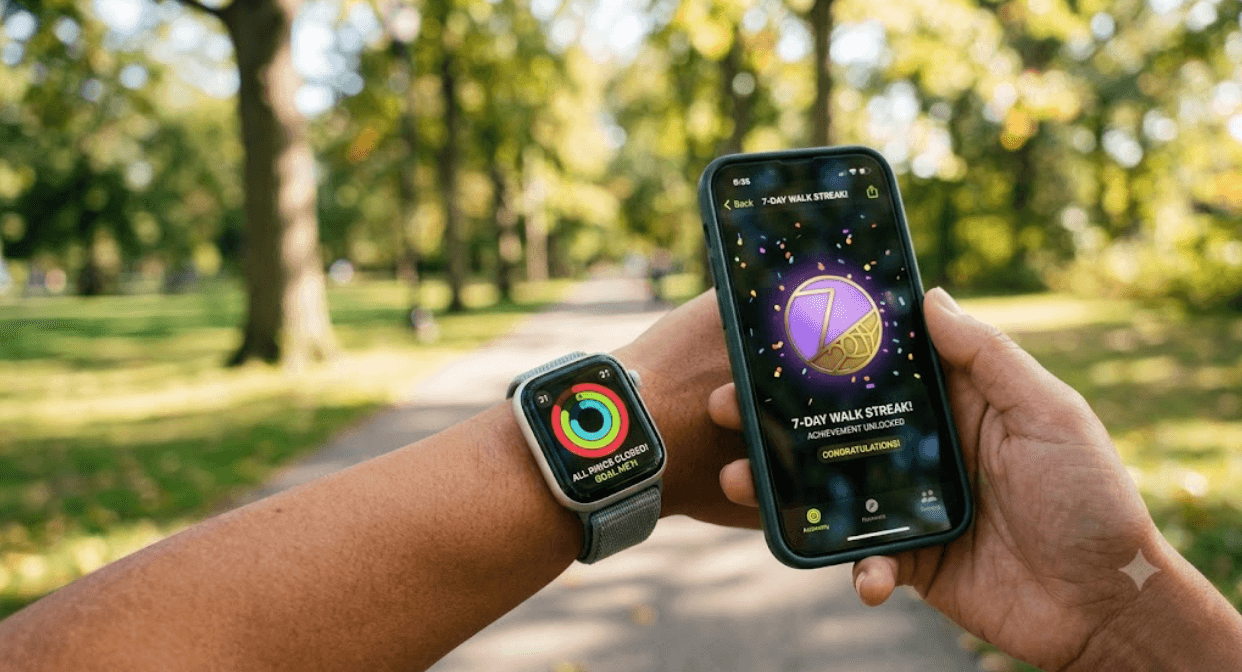
This is precisely the gap Xcellent Life is built to close. Rather than treating activity tracking as a passive dashboard — step counts that pile up with no real incentive attached — Xcellent Life's platform is designed around a reward system that makes consistent activity genuinely motivating, even for people who are starting from a very inactive baseline.
The goal isn't to turn already-active people into athletes. It's to move people along the entire activity spectrum — particularly the people who need it most: those currently very inactive. By connecting real-time data from biometric sensors, wearables, and mobile tracking into a single platform, and pairing that data with a reward structure that recognizes effort and consistency (not just outcomes), the system is designed to create the kind of immediate, tangible feedback loop that the research above shows actually works. Small, consistent wins — recognized and rewarded along the way — are what convert "I should probably exercise" into an actual, repeated behavior.
This matters because the employer wellness data is unambiguous on one point: programs that successfully shift activity levels don't just improve individual health outcomes, they reduce the very presenteeism and absenteeism costs outlined earlier. When employees move from sedentary to active, the comorbidities tied to inactivity — fatigue, joint pain, poor sleep, low mood — tend to ease as well, which is exactly the chain of cause and effect that drives those billions of dollars in lost productivity.
The Bigger Picture
Obesity is a complex, multi-causal condition, and no single program or app is a substitute for medical care, nutrition, and individual circumstances. But activity level is one of the most modifiable pieces of the puzzle, and it's also one of the pieces most responsive to smart program design. The data is consistent: reward-based, feedback-driven systems outperform generic encouragement, and they outperform it specifically among the people who are currently the least active — the group with the most to gain.
That's the bet behind Xcellent Life's approach: that the right technology, paired with a reward system built on real behavioral science, can move people from inactive to active in a way that sticks — and that the ripple effects of that shift extend well beyond the scale, into energy, focus, and the ability to actually get things done.
Sources: Centers for Disease Control and Prevention (CDC), National Health and Nutrition Examination Survey (NHANES); American Heart Association; PubMed/National Library of Medicine (Journal of Occupational and Environmental Medicine; Nutrition & Diabetes; PMC systematic reviews on gamification and physical activity); Endocrine Society; ClinicalTrials.gov.