
The Real Cost of Doing Nothing: What a 500-Person Pilot Tells Us About the ROI of Xcellent Life
YL
Every benefits leader knows the number by heart: healthcare costs go up every year, seemingly no matter what you do. In 2025, employer healthcare cost trend hit almost 8% — the highest increase in more than a decade, according to the Business Group on Health's 2025 Employer Health Care Strategy Survey. In some states, it's running as high as 10%.
The instinct in years like this is to manage costs from the outside in — tighter plan design, higher deductibles, narrower networks. But the data increasingly points to a different lever: what happens before someone becomes a claim.
We recently ran a 500-person pilot of the Xcellent Life platform to test exactly that question — not "will people use a wellness app," but "does sustained engagement with health behaviors actually move the numbers that matter to a CFO." The results were significant enough that we think every organization evaluating its 2027 benefits strategy should see them.
Why Chronic Conditions Are the Real Budget Problem
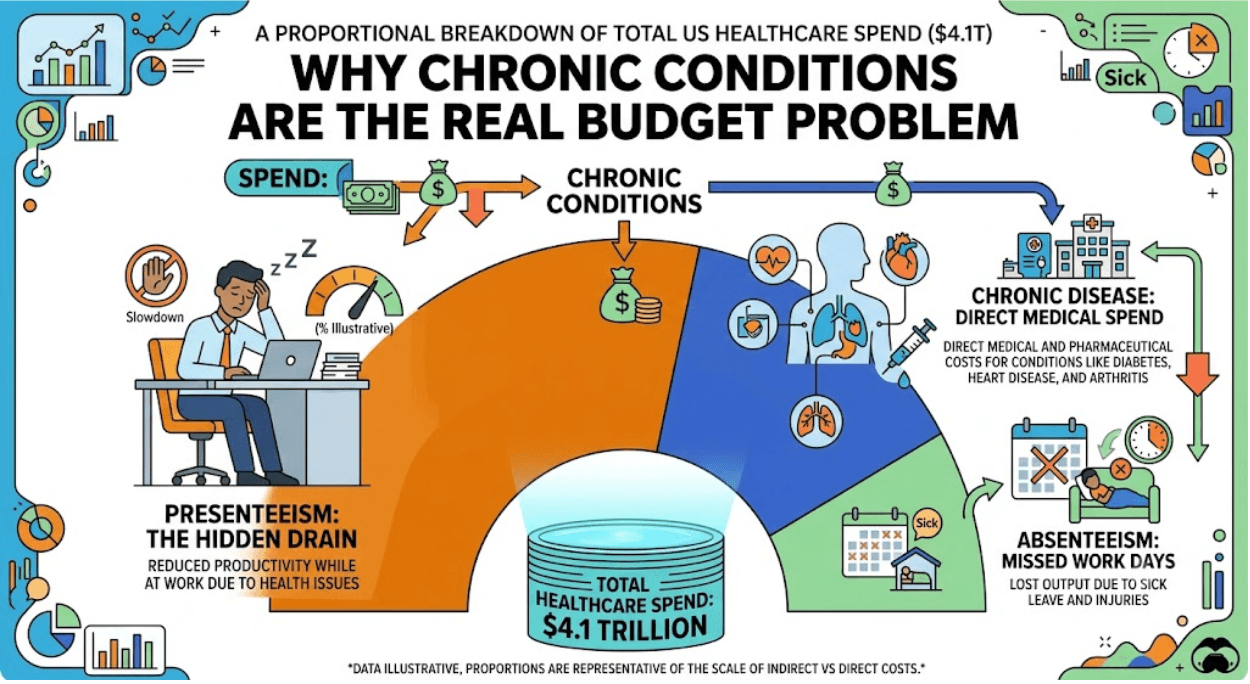
Before getting into the pilot results, it's worth grounding this in the scale of the problem Xcellent Life is built to address. According to the CDC, chronic diseases and mental health conditions now account for roughly 90% of the nation's $4.1 trillion in annual healthcare spending. That's not a hospital problem or an insurer problem — it's an employer problem, because employers are the ones absorbing the downstream costs.
Those downstream costs show up in two places. First, direct claims: diabetes alone cost the U.S. $413 billion in 2022. Second, and often underestimated, indirect costs — absenteeism and presenteeism. The CDC estimates absenteeism-related productivity losses at $225.8 billion a year nationally, and a 2025 analysis found employers lose an average of $2,945 per employee, per year, to absenteeism and presenteeism tied to chronic illness. Zoom out further and the Partnership to Fight Chronic Disease projects chronic disease could cost U.S. employers $794 billion annually in lost productivity by 2030.
In other words: the money is already leaving the building. The only question is whether it's being spent reactively, on claims and lost workdays, or proactively, on the behaviors that prevent them in the first place.
What We Tested
The pilot brought 500 participants from a range of partner organizations onto the Xcellent Life app and measured outcomes across four dimensions: behavior change, health awareness, overall health improvement, and — the one that matters most to a benefits budget — healthcare-associated cost reduction. Each metric used a pre/post design: a baseline survey or assessment, a post-program survey or assessment, and a calculated percentage change.
What makes this pilot more useful than a typical vendor case study is that it didn't treat "users" as one bucket. The 500 participants split naturally into three engagement tiers:
- 50 non-active users (10%) — downloaded the app but never meaningfully engaged with it
- 100 active users (20%) — downloaded the app and used it consistently
- 350 competition participants (70%) — used the app consistently and took part in Xcellent Life's wellness competitions
That structure turns out to be the most important thing in the dataset, because it lets us isolate engagement as a variable rather than just reporting an average across everyone.
The Dose-Response Effect: More Engagement, Measurably Better Outcomes
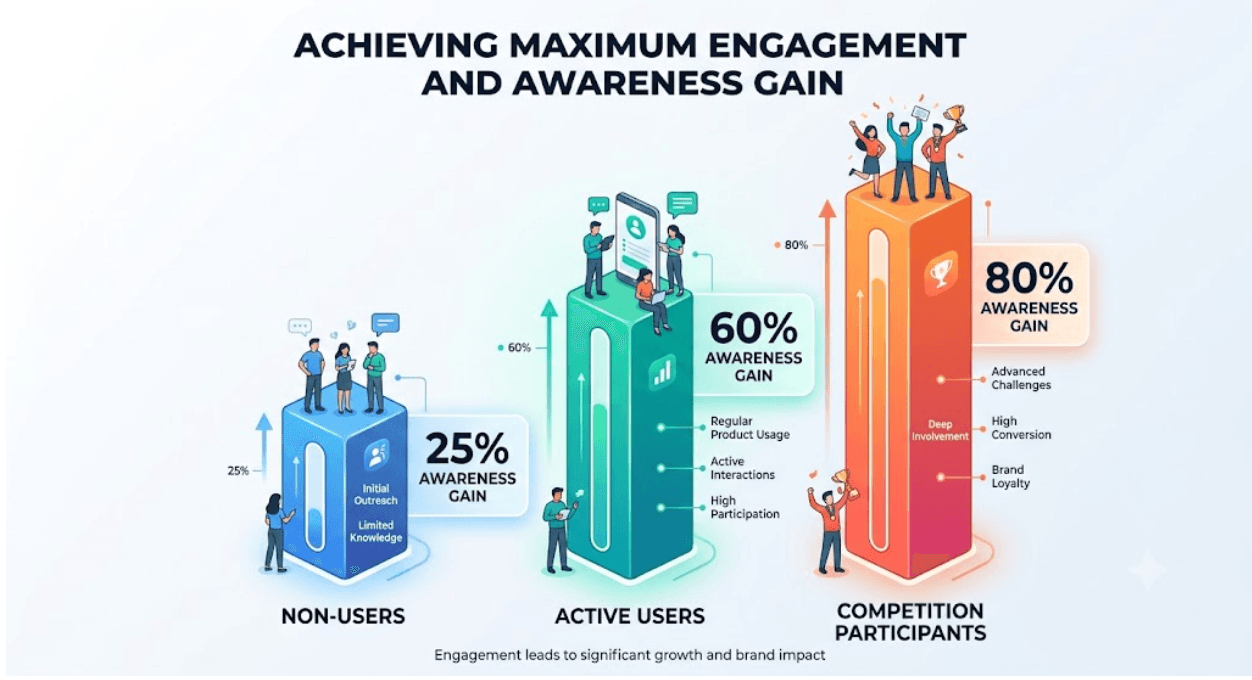
Across every metric in the pilot, the pattern is consistent — and it's the kind of pattern that should make any benefits leader sit up. Outcomes scaled directly with engagement level.
Health awareness improvement: Non-users improved their health and wellness awareness scores by just 25%. Active app users improved by 60%. Competition participants — the most engaged tier — improved by 80%. That's more than triple the gain of the non-engaged group, from the identical underlying platform. The app itself isn't the intervention; sustained engagement is.
Health incidents over six months: Tracked monthly, non-users consistently reported the highest number of health incidents, peaking at five in a single month and rarely dropping below two. Competition participants, by contrast, held steady near zero to one incident per month for the full six-month period — the flattest, lowest line on the chart. Active users landed in between, trending downward but with more volatility than the competition group.
Overall increase in healthy behaviors: Aggregated across the full population, the pilot recorded an 80% overall increase in healthy behaviors — a striking number for a six-month window, and one that lines up with the incident and awareness data rather than standing apart from it.
Taken together, this isn't three disconnected charts. It's a single dose-response curve: the more deeply someone engages with Xcellent Life's platform — particularly through the social, gamified structure of wellness competitions — the fewer health incidents they report, the more their awareness improves, and the more durable their behavior change becomes. That's a meaningfully different claim than "our app has good engagement." It's evidence that the type of engagement Xcellent Life is designed to drive is the mechanism producing the outcome.
Translating That Into Dollars
Here's where it becomes a budget conversation rather than a wellness conversation. Using the incident-rate data from the pilot compared against researched industry averages for incident frequency and average cost per incident, the modeled healthcare-associated cost reduction across the full 500-person population came out to 45%.
The math behind that figure is straightforward and auditable: expected incidents were calculated by applying an industry-average incident rate per 100 individuals to the pilot population, then multiplying by an average cost per incident to produce an expected cost baseline. That baseline was then compared to the actual, lower number of incidents observed in the pilot population, multiplied by the same average cost. The delta — 45% — is the estimated savings attributable to the shift in incident rates the program produced.
To put that in real terms for organizations sizing this against their own population: if a mid-sized employer of 1,000 employees is currently exposed to roughly $2,945 per employee per year in absenteeism- and presenteeism-related costs alone (the national average cited above, before even layering in direct claims costs), that's nearly $2.95 million in annual indirect cost exposure tied to unmanaged chronic health risk. A 45% improvement trend applied against that kind of baseline — even conservatively, and even before accounting for hard claims savings — represents a seven-figure opportunity for many mid-market employers. These are illustrative, order-of-magnitude figures based on published national averages, not a guarantee for any specific organization, but they show the scale of what's on the table.
How This Compares to the Broader Wellness ROI Research
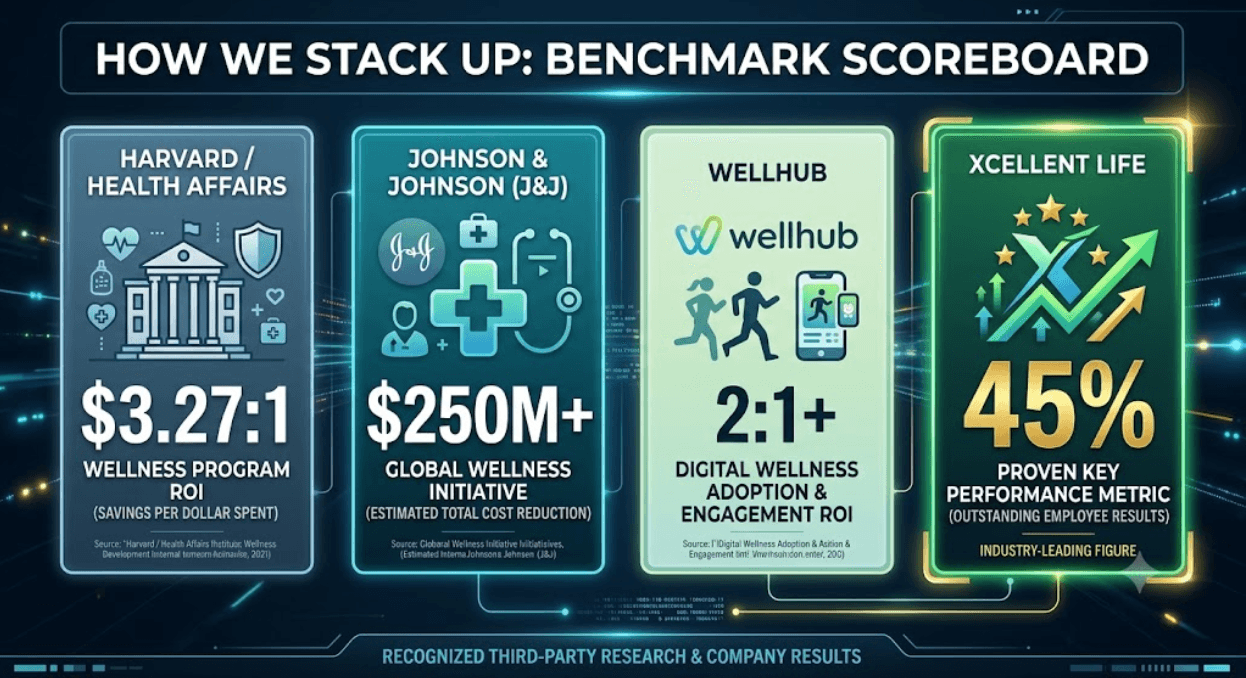
It's worth stress-testing the pilot's 45% figure against the wider body of research on workplace wellness ROI, because it turns out Xcellent Life's results sit squarely inside — and in some respects ahead of — what's been documented at scale elsewhere:
- Johnson & Johnson's long-running wellness program saved the company an estimated $250 million in healthcare costs over roughly a decade, returning $2.71 for every dollar spent.
- A meta-analysis of over 30 studies published in Health Affairs found that well-designed workplace wellness programs return $3.27 per dollar invested in reduced medical costs and an additional $2.73 per dollar in reduced absenteeism costs — a combined $6 return for every $1 spent.
- A RAND Corporation analysis of 10-year data from a Fortune 100 employer found that the disease management component of its wellness program returned $3.80 for every dollar invested, driven largely by a 30% reduction in hospital admissions.
The throughline in all of this research is the same one visible in the Xcellent Life pilot: programs that drive sustained, social, comprehensive engagement — not just a downloaded app — are the ones that move the cost curve. Xcellent Life's wellness-competition structure is purpose-built around that exact mechanism, which is almost certainly why 70% of this pilot's population chose to engage at the highest tier rather than churning out after week one, a retention rate that outpaces what most single-feature wellness apps achieve.
What This Means If You're Evaluating Options for Your Population
Every organization sizing up a wellness or population-health vendor is really asking two questions: will people actually use it, and if they do, will it show up in the budget. This pilot answers both. Ninety percent of the pilot population (450 of 500 people) engaged with the app at some level, and 70% engaged at the highest tier — the one that produced the strongest awareness gains, the fewest health incidents, and the largest modeled cost reduction.
For a benefits or HR leader building next year's healthcare cost strategy, the takeaway isn't "wellness apps work." It's more specific than that: engagement structure matters, and Xcellent Life's competition-driven model is designed to produce the specific kind of high-frequency, socially reinforced engagement that the research — both this pilot and the broader literature — shows is required to actually bend the cost curve.
We believe these results scale. The pilot's methodology was designed to be replicable across an untreated population of any size, and we'd welcome the opportunity to walk your team through what a modeled cost-reduction scenario could look like for your specific population.
If you'd like to see a customized projection based on your organization's size and current healthcare cost exposure, reach out to your Xcellent Life representative or schedule a consultation — we'll build the model with you.
Sources
Business Group on Health, 2025 Employer Health Care Strategy Survey, cited in Marathon Health, "The Effect of Chronic Conditions and Missed Care on Employers," 2025.
Centers for Disease Control and Prevention (CDC), chronic disease and healthcare spending statistics, cited in McGohan Brabender, "Chronic Conditions: The Hidden Cost Driver for Employers," 2025.
CDC, absenteeism productivity loss estimate ($225.8B/year), cited in Cedar Gate Technologies, "The U.S. Health Disadvantage Costs Employers Billions Every Year," 2024.
Marathon Health, "The Effect of Chronic Conditions and Missed Care on Employers," 2025 ($2,945 per employee/year in absenteeism and presenteeism costs).
Partnership to Fight Chronic Disease, projected 2030 employer productivity costs, cited in Cedar Gate Technologies, 2024.
Harvard Business Review case study on Johnson & Johnson's wellness program savings, cited in Questco, "What Is the Actual ROI of Corporate Wellness Programs?" 2025.
Wellhub, 2024 Return on Wellbeing Report, May 2024.
RAND Corporation study on employer healthcare cost reduction per member, cited in Questco, 2025.
Internal pilot data and calculation methodology sourced from the Xcellent Life 500-User Wellness Pilot Report.
Link to Xcellent Life: http://xcellentlife.com/