
Why Customer Testimonials Are the Engine Behind Software GrowthNew Post
YL
There's a quiet truth in the software world that many companies overlook: the most persuasive marketing you'll ever have doesn't come from your marketing team. It comes from the people who already use your product and are willing to say, out loud and on the record, that it made their lives better.
At Xcellent Life, we build software designed to improve the wellbeing of the people who use it. So we think about the user experience constantly — not just because a good experience keeps people around, but because a good experience is the very thing that produces the honest, enthusiastic testimonials that grow a business. Those two ideas are deeply connected, and understanding how they connect is one of the most valuable things a software company can do.
Let's walk through why testimonials matter so much, what the data says about companies that use them versus those that don't, and how the whole cycle starts with something surprisingly simple: making sure your users are genuinely satisfied.
Trust Is the Currency of Software Buying
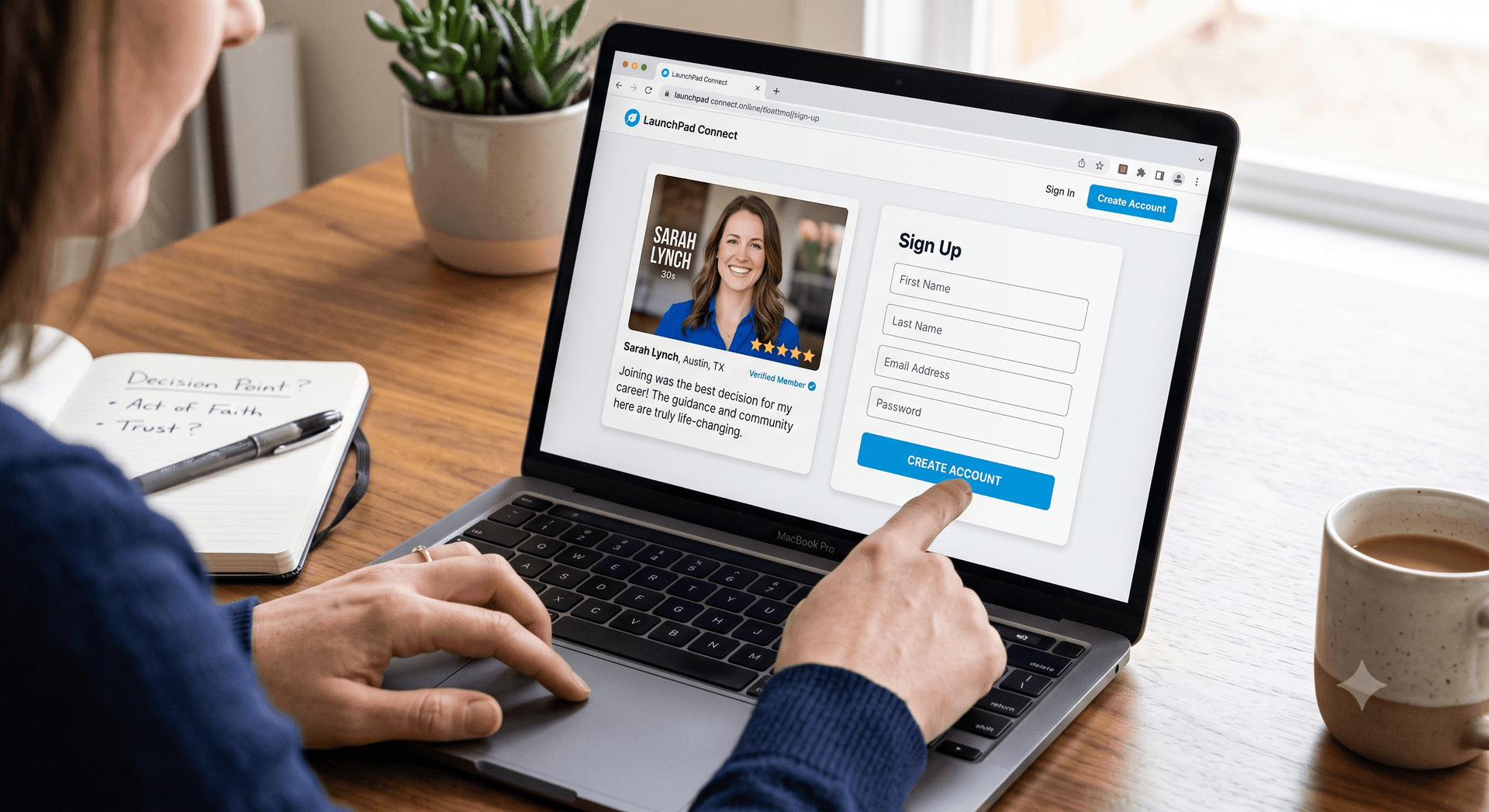
Buying software is an act of faith. A prospective customer can't hold your product in their hands, kick the tires, or take it for a test drive the way they might a car. They're being asked to commit — often with budget, time, and their own professional reputation on the line — to a solution they can't fully evaluate until after they've bought it.
That's exactly why trust signals carry so much weight. Research consistently shows that B2B conversion rates are strongly correlated with visible trust signals like customer logos, case study results, review scores, and named testimonials — and that pages lacking these almost universally perform below benchmark. For software specifically, this matters even more, because trust signals have to compensate for the fact that buyers can't physically experience the product before committing.
A testimonial does something no amount of clever copywriting can replicate. It hands the microphone to someone who has no financial stake in your pitch and lets them describe, in their own words, what changed for them. That authenticity is the entire point. In B2B transactions, trust is the linchpin of successful partnerships, and testimonials serve as genuine endorsements that give prospects a real narrative of a company's reliability and competence.
The Numbers: Companies With Testimonials vs. Those Without
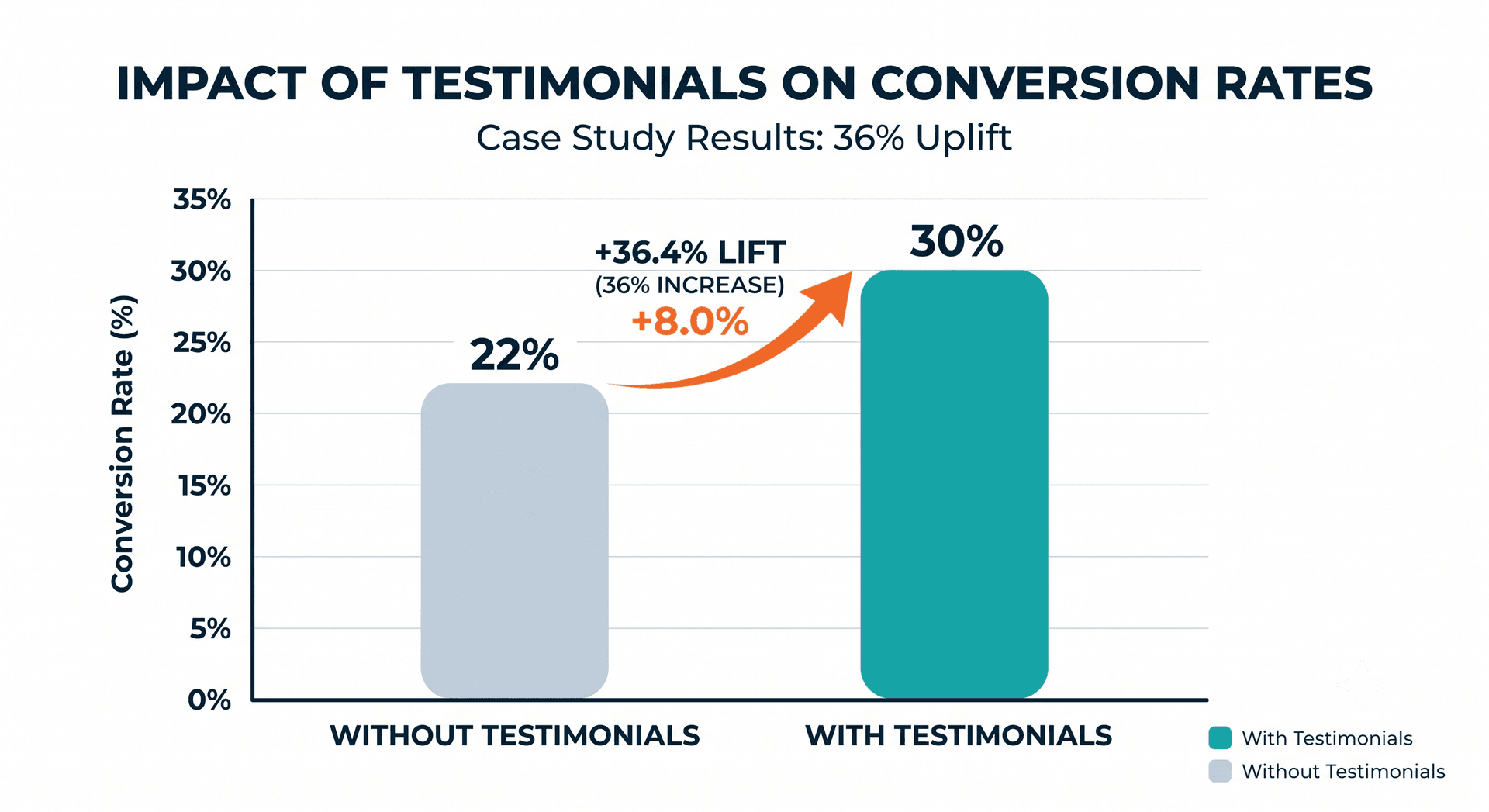
It's one thing to say testimonials build trust. It's another to look at what actually happens to conversion rates when companies use them well. The data here is striking, and it consistently points in one direction.
Testimonials near the point of decision can dramatically lift conversions. Placing testimonials or trust signals near calls-to-action or signup forms has been found to increase conversions by anywhere from 84% to 270%, while burying that same social proof in a footer significantly reduces its impact. In other words, it's not just whether you have testimonials — it's whether you put them where people are actually making a decision.
Social proof reliably moves the needle. Across industries, testimonials and social proof elements have been shown to boost conversions by roughly 34%. For B2B SaaS specifically, authentic, multi-format social proof — especially reviews and video testimonials — has been found to boost conversions by up to 270%, with companies displaying social proof seeing conversion rate increases of up to 34%.
In FinTech and other trust-sensitive software categories, the gap is enormous. Companies that prominently display security certifications, compliance badges, and customer testimonials can see conversion rates up to 40% higher than competitors who don't. When you consider that the average B2B SaaS conversion rate hovers around just 1.1%, a lift of that magnitude isn't a marginal improvement — it's the difference between a struggling funnel and a thriving one.
Real companies see real, measurable results. These aren't just abstract percentages. Oracle NetSuite increased form submissions by 30% by reducing required form fields and adding customer testimonials. Buildium, a property management software company, increased free-trial signups by 22% simply by improving how it presented the testimonials on its homepage — a reminder that even the framing and placement of a testimonial can meaningfully change outcomes.
Put simply: software companies that surface authentic customer voices consistently outperform those that don't. The absence of testimonials isn't neutral — it's a missed opportunity that shows up directly in the conversion numbers.
Connecting the Dots: Satisfaction Comes First
Here's where the story gets interesting, and where Xcellent Life's philosophy really comes into focus. You cannot manufacture a great testimonial. You can only earn it. And you earn it by delivering an experience so good that a user wants to talk about it.
Think of it as a ladder. Customer satisfaction is the first rung — the customer's expectations were met during a specific interaction. From there, satisfied customers become repeat customers, then supporters who choose your brand over competitors, and finally advocates who recommend you to others, write reviews, and defend your brand publicly. Testimonials live at the top of that ladder. They are what satisfaction becomes when it's given room to grow.
The research backs this up at every level. High customer satisfaction turns happy customers into a company's best ambassadors, providing social proof through positive reviews and recommendations that enhance credibility. Customer advocacy — referrals, testimonials, and social proof — happens specifically because customers have had consistently excellent experiences. And the warning that comes attached to this is just as important: a program that chases reviews without genuine satisfaction behind them can actually damage trust, because advocacy only works when it's built on real positive experiences.
There's even a compounding effect worth noting. When satisfaction is high, customers are disproportionately more likely to communicate their pleasure to others. Satisfaction doesn't just produce a testimonial — it produces enthusiasm, and enthusiasm is what makes a testimonial persuasive.
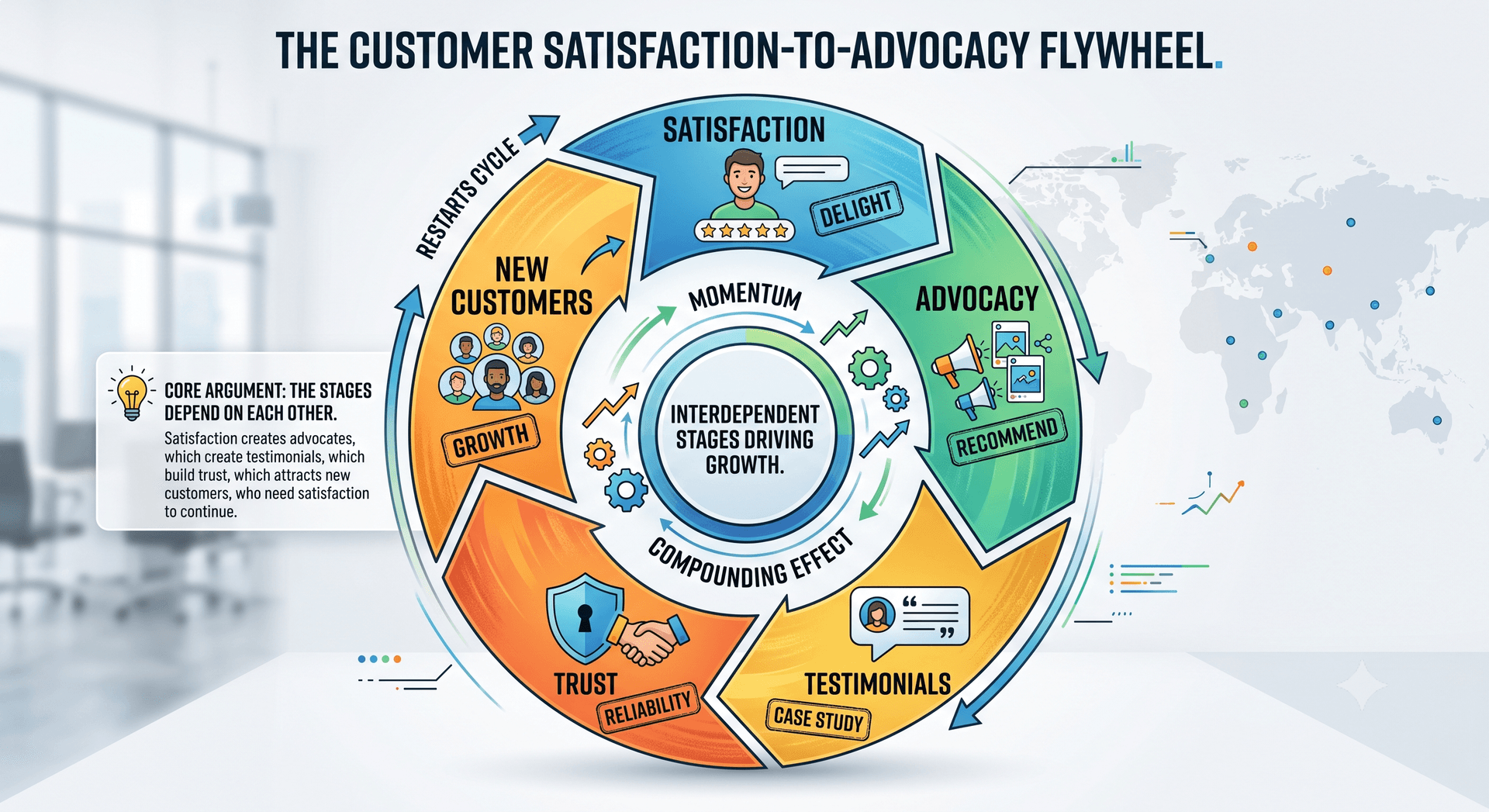
This is the loop that drives sustainable growth:
You deliver a genuinely good user experience. The product works, the onboarding is smooth, the support is responsive, and the user achieves the outcome they came for.
That experience produces real satisfaction. The user feels their expectations were met or exceeded.
Satisfied users become willing advocates. They agree to give a testimonial, leave a review, or share their story — because they mean it.
Those testimonials build trust with new prospects. The authentic voice of a happy user lowers the risk for the next buyer and lifts conversion rates.
New customers enter the same experience-first cycle — and the loop compounds.
Every stage depends on the one before it. Skip the satisfaction step and the whole thing collapses, because testimonials extracted from indifferent or frustrated users ring hollow and can even backfire.
Why This Matters More for Software Than Almost Anything Else
Software has a unique advantage and a unique challenge when it comes to this cycle. The challenge is that, as we noted, buyers can't touch the product before buying. The advantage is that software companies have an unusually rich, ongoing relationship with their users. Every login, every feature used, every support ticket resolved is a chance to build — or erode — satisfaction.
That's also why the timing of a testimonial request matters. The best moment to ask often isn't the day someone signs up, but several months later, when the customer is in a steady "business as usual" rhythm and can speak realistically about the value they've received. A testimonial gathered at that moment of genuine value is worth far more than one collected before the user has truly experienced the product.
For a wellbeing-focused company like Xcellent Life, this alignment is especially natural. Our entire reason for existing is to help people live better through better software. When we succeed at that mission, satisfied users don't just renew — they tell their story. And those stories become the most credible, most convincing case we could ever make to the next person deciding whether our solution is right for them.
The Takeaway
Testimonials aren't a marketing afterthought or a box to check on a landing page. They are the visible output of an invisible commitment to your users' experience. The companies that win are the ones that recognize the full chain: satisfaction produces advocacy, advocacy produces testimonials, and testimonials produce trust that converts prospects into customers.
The data is unambiguous. Well-placed social proof can lift conversions by double and even triple digits, real companies have measurably grown their signups by adding and refining testimonials, and software buyers routinely rely on the voices of existing users to make their decisions. But none of it works without the foundation — a product experience worth talking about.
So the most strategic thing a software company can do isn't to chase testimonials directly. It's to obsess over the user experience, deliver real satisfaction, and then make it easy for happy users to share their stories. Do that consistently, and the testimonials — and the growth that follows them — take care of themselves.
That's the philosophy we live by at Xcellent Life. Build something people genuinely love, and they'll help you build the rest.
Sources
M Accelerator — B2B SaaS Conversion Rate Benchmarks 2025 (FinTech trust signals and up-to-40% conversion lift): https://maccelerator.la/en/blog/entrepreneurship/b2b-saas-conversion-rate-benchmarks-2025/
Predictable Profits — B2B CRO Benchmarks by Industry 2025 (Oracle NetSuite 30% form-submission increase; B2B SaaS ~1.1% conversion rate): https://predictableprofits.com/b2b-cro-benchmarks-by-industry-2025/
Pixelswithin — B2B SaaS Conversion Benchmarks + Revenue Gap Analysis 2026 (social proof placement lifting conversions 84–270%): https://pixelswithin.com/b2b-saas-conversion-benchmarks-2026/
Stackmatix — Website Conversion Rate Benchmarks by Industry in 2026 (trust signals correlated with B2B conversion): https://www.stackmatix.com/blog/website-conversion-rate-benchmarks
Surface Labs — B2B Lead Conversion Benchmarks for 2025 (Genesys Growth 2026: social proof boosting conversions up to 270%, up to 34% increase): https://withsurface.com/blog/b2b-lead-conversion-benchmarks-for-2025
SQ Magazine — Conversion Rate Optimization Statistics 2026 (testimonials/social proof ~34% conversion lift): https://sqmagazine.co.uk/conversion-rate-optimization-statistics/
VWO — 43 Conversion Rate Optimization Statistics 2026 (Buildium 22% free-trial signup increase): https://vwo.com/conversion-rate-optimization/conversion-rate-optimization-statistics/
B2B Rocket — Analyzing Customer Testimonial Impact on B2B Conversions (testimonials as trust-building endorsements): https://www.b2brocket.ai/blog-posts/analyzing-customer-testimonial-impact-on-b2b-conversions
Zendesk — Customer Satisfaction: What It Is and Why It Matters (satisfaction driving referrals and advocacy): https://www.zendesk.com/blog/customer-service/satisfaction/customer-satisfaction/
Nutshell — Customer Advocacy: How It Works, Strategy, and Metrics (advocacy arising from consistently excellent experiences): https://www.nutshell.com/engagement/resources/customer-advocacy
AskNicely — Customer Satisfaction and Loyalty: Complete Guide (the satisfaction-to-advocacy ladder): https://www.asknicely.com/blog/customer-satisfaction-vs-customer-loyalty
QuestionPro — Customer Advocacy: How It Works, Strategy, and Metrics (advocacy must be built on real satisfaction): https://www.questionpro.com/blog/customer-advocacy/
Outside In Management — Why Customer Satisfaction Equals Referrals (the moment-of-truth timing for testimonials): https://outsideinmanagement.co.uk/why-customer-satisfaction-equals-referrals/
Link to Xcellent Life: xcellentlife.com