
Why fancy technology isn't enough: designing the way for it to actually work
Jl

Every organization has its own graveyard, a technology graveyard where technology that the companies bought are abandoned. This would not sound convincing at first glance: why would companies never use the technology that they bought for an expensive price?
The problem is never the technology itself. It’s always the fit problem.
The most important question in any digital transformation isn't "what can this technology do?" It's "does this technology fit into how our people already work, think, and solve problems?" When the answer is yes, technology becomes invisible in the best possible way — it saves time, cuts costs, improves outcomes, and earns genuine enthusiasm from the people using it. When the answer is no, even the most sophisticated tool becomes shelfware, and the organization pays for it twice: once to buy it, and again in the lost productivity, workarounds, and missed opportunity that follow.
The Problem: Impressive technology, devastating adoption.
To go into depth, the data on failed adoption is remarkably consistent, and remarkably sobering.

Start with digital transformation as a whole. Bain's 2024 research found that 88% of business transformations fail to achieve their original ambitions, and industry analysis puts the broader failure rate for digital transformation initiatives at roughly 70%, with these failed efforts costing organizations an estimated $2.3 trillion globally every year. A Gartner survey found that only about 48% of transformation projects fully meet or exceed their targets — meaning more than half fall short even by the standards their own sponsors set.
Zoom in on specific enterprise tools and the picture doesn't improve. CRM and ERP rollouts — the software every large organization eventually touches — fail at nearly the same rate: 50–63% of CRM adoption initiatives fail, according to industry research, with employees quietly reverting to spreadsheets and email because the new system never became part of how they actually work.
And AI, the technology receiving the most investment and attention right now, is following the exact same pattern, just faster and more expensively. RAND Corporation research found that more than 80% of AI projects fail — twice the failure rate of non-AI IT projects. S&P Global reported that 42% of companies abandoned most of their AI initiatives in 2025, up from just 17% the year before. And even where AI has technically been deployed, only 7% of organizationssay it's fully integrated across the business, despite 88% reporting some use of it somewhere.
Three very different technologies. Three very different budgets, timelines, and levels of executive attention. And yet the failure rate lands in nearly the same range every time — somewhere between half and nine-tenths of these initiatives never deliver what they were bought to deliver.
That consistency is the real story here. If the failure rate were unique to CRM, you could blame CRM. If it were unique to AI, you could blame AI's immaturity. But when digital transformation broadly, enterprise software specifically, and today's most hyped technology all fail at roughly the same rate, the common denominator isn't the technology category at all. It's something the technology is being layered onto — or rather, failing to be layered onto correctly.
The root cause, again, is workflow misalignment. Gartner attributes 85% of AI project failures to poor data quality or a lack of workflow-relevant data — a readiness problem, not a capability problem. McKinsey's 2025 research adds a telling detail: organizations that report significant financial returns from AI are twice as likely to have redesigned their end-to-end workflows before selecting the technology, not after. And one industry analysis of enterprise technology failures put it plainly: organizations that select the technology first and then try to force their existing processes to fit it "consistently produce lower adoption and lower business" value than organizations that design the process and the technology together. In other words, the misalignment of workflow has yielded such devastating results, which could have been the turning point and the successful outcome of the company if adopted in the right direction.
The Opportunity: When Technology Fits, Everything Changes
On the other hand, let’s look at the cases where technology is adopted fittingly. It creates a whole new result and is where the real opportunity emerges.
Start with the return on investment when usability is treated as a first-class design requirement rather than an afterthought. Forrester Research found that for every dollar invested in UX, the average return is $100 — a 9,900% ROI. That number sounds almost implausible until you consider what it actually reflects: fewer support tickets, faster onboarding, less rework, and higher first-time task completion.
Now look at what happens when that same principle plays out inside a specific, high-stakes workflow: clinical care. Healthcare organizations that redesign their technology around existing clinical workflows — rather than forcing clinicians to adapt to the software — see something striking: every minute a clinician spends fighting a poorly designed interface is a minute of clinical or billable time lost, and when that friction is designed away, the hours saved translate directly into measurable cost reduction and higher satisfaction, for both the people delivering care and the people receiving it.
A near-100x return in one case. Direct, measurable time and cost recovery in the other. Two completely different industries, two completely different metrics — and yet the same underlying cause sits behind both numbers.
Neither of these results comes from the technology itself. Both come from adoption. A $100 return on every UX dollar isn't a reward for better software engineering — it's a reward for a tool people actually opened, learned, and kept using instead of abandoning. The hours clinicians get back aren't a byproduct of a more powerful system — they're a byproduct of a system clinicians didn't have to fight in the first place. Strip away the surface-level differences between these two examples and what's left is the same mechanism at work: technology designed around the user's existing workflow gets adopted, and adoption is what converts a technology investment into an actual return.
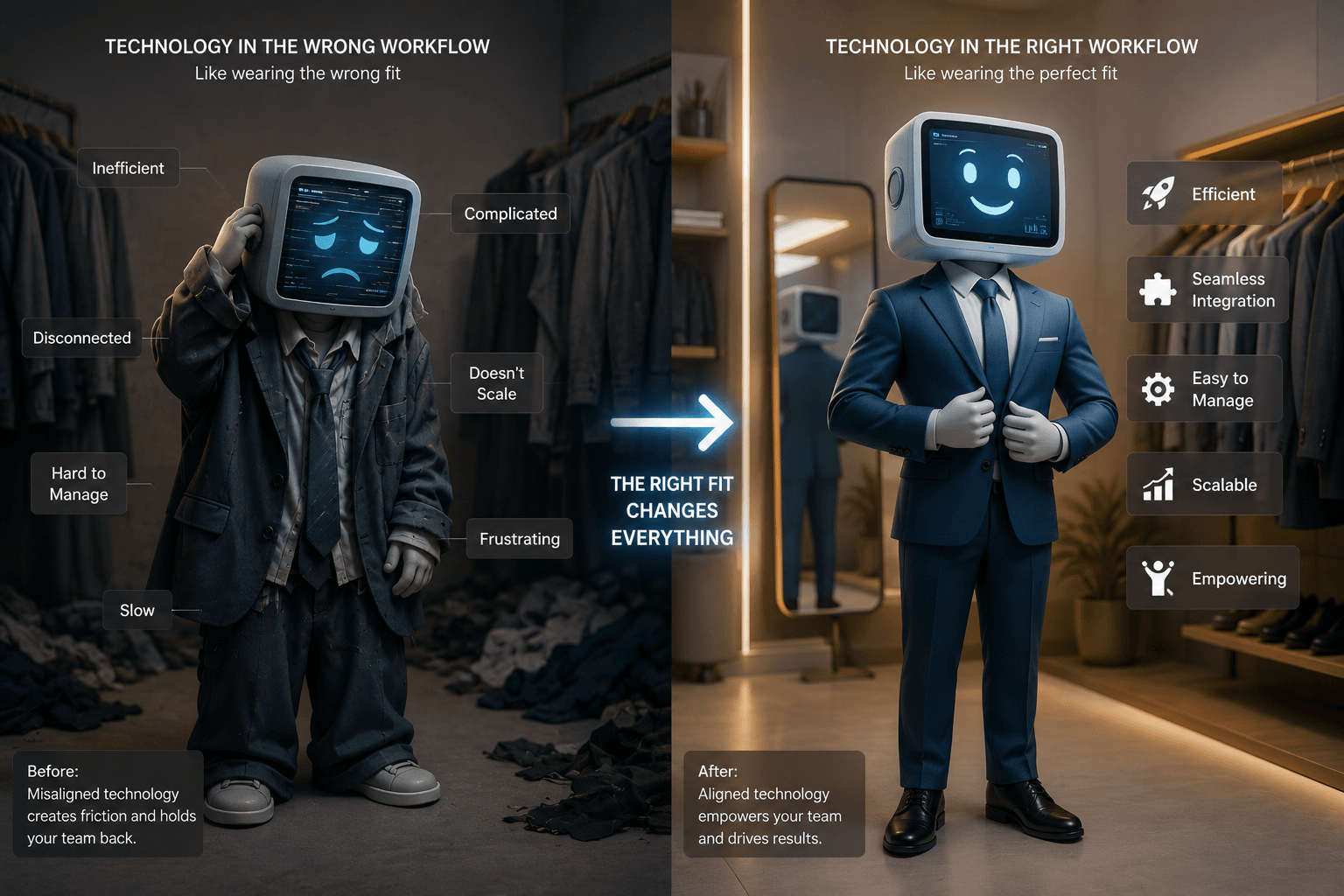
This is the piece most organizations underestimate. It's tempting to believe that better technology produces better outcomes. However, comparing the results of failed adoption and the successful ones, the difference between adopting a workflow and not doing so is like night and day. The data says something more precise: workflow-fit adoption is what produces better outcomes — and the technology is only ever the vehicle for it. Two organizations can buy the exact same platform, spend the exact same budget, and land on opposite ends of these statistics, purely based on whether the rollout was designed around how people already work or designed around what the technology could theoretically do. That single variable — adoption driven by workflow fit — is capable of separating a 9,900% return from a write-off, and a clinical workflow that gives hours back from one that quietly drains them. When the fit is right, the gap in outcomes isn't marginal. It's the difference between the numbers in the Problem section above and the numbers in this one.
The Missing Ingredient: Expertise That Has Actually Done This Before

Here's what the statistics above don't fully capture: knowing that workflow fit matters and knowing how to design for it under real organizational constraints are two very different skill sets.
Most organizations don't fail at digital transformation because they lack ambition or budget. They fail because the people making technology decisions are experts in their own domain — clinical care, operations, finance — but not necessarily experts in translating that domain's real-world workflow into a system people will actually adopt. That translation work is a discipline in its own right, and it's one most internal teams have never had the chance to build, simply because most organizations only go through a handful of major digital transformations in a career, not dozens.
This is exactly the gap that seasoned leadership closes. Leaders who have navigated multiple technology transformations — across different organizations, different user populations, and different failure modes — bring pattern recognition that can't be shortcut. They've seen which "obvious" technical decisions quietly break adoption six months later. They've seen which workflow compromises are worth making and which ones erode trust in the system permanently. They know how to ask the questions that surface a mismatch between technology and workflow before the organization has spent the budget, not after.
How can Xcellent Life help in light of this matter?
This is where Xcellent Life brings deep, hard-won expertise to organizations navigating digital transformation.Rather than starting with a technology and asking users to adapt, Xcellent Life starts with the people: their ability, their interest, their existing workflow, and the actual problem they need solved. That expertise — built through direct experience designing and deploying technology that people genuinely want to use — is what allows organizations to land on the right side of the statistics above: to be among the minority whose digital transformation delivers the time savings, cost reduction, improved outcomes, and user delight the investment was meant to produce, rather than joining the majority who quietly write off the spend.
The difference between a technology rollout that transforms an organization and one that becomes an expensive cautionary tale usually isn't the sophistication of the tool. It's whether someone who has done this before was in the room helping design it around the humans who'd actually be using it every day.
Join the Conversation
This is a topic worth more than a single blog post — it's a conversation. Xcellent Life's CEO will be hosting a roundtable discussion on exactly this subject, bringing together other experts in the space to dig into what it really takes to empower people and organizations through digital transformation — not just to deploy new technology, but to make sure it actually gets used, trusted, and valued by the people it was built for.
Link to round table discussion
https://l.gourl.es/l/dc11ed0fe5474bed26b6782c8dba41fd9dbddc1d?u=10403347